Architecture & Master Planning
NINGBO: A Creative Hub, China 2011
Client: Dada Group. Salò, Italy and Ningbo, China.
Team: Dr Ken Yeang, Robert Powell, Riet Eeckhout, Asako Hayashi, See Ching Toh, Gianluca Ruggeri, Adam Johnson, Carl Malony, Sylvie Milosevic, Steve Biggs, Ting Lam Tang, King Foo Yiu.


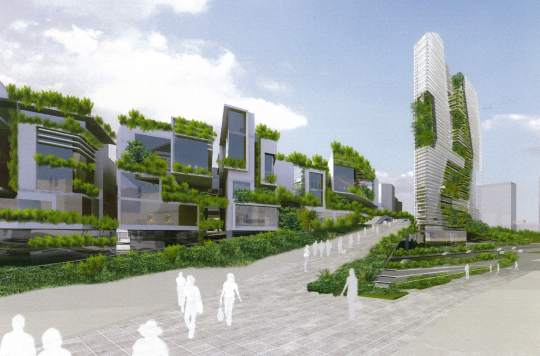
In 2011 Llewelyn Davies Yeang were commissioned to design a masterplan for NINGBO – A Creative Hub, intended to be the focus for the fashion industry in the Asia Pacific Region. The plan produces 1 million square metres of commercial and residential floorspace. The majority of the site including the central area and the northern and southern boundaries will be occupied by the fashion showrooms of the world’s top-100 brands accessed by an intricate series of ramps, walkways, elevators and escalators woven together in an intricate pattern of streets and plazas. A fashion museum, design schools and conference/convention centre are also located here. Conceptually three ‘fingers’ of urban development extend towards the waterfront and between these fingers are ‘green fingers’ or ‘landscaped ribbons’, that reach inland from the riverside promenade and connect to the City Park. An inlet along the riverbank is extended eastwards in the form of a water garden. Three large plazas are created that will have retractable glazed roofs that can be closed during the winter months (November to February) and opened in late spring, summer and early autumn (March to October) when weather conditions permit to permit outdoor fashion events and concerts.
The form that emerges is a kaleidoscope of spatial experiences, with large open plazas contrasting with narrower compressed linear spaces and dynamic vertical connections. The fragmented plan of the Creative Hub intentionally subverts the strict orthogonal masterplan of the city providing a visual and sensory experience that invites exploration and denies an instant reading. The constantly changing window displays and lighting designed by the fashion houses will enhance the sense of the transitory nature of the fashion world. The design blends elements of traditional and futuristic space that provides a permanent ‘catwalk’, a place to see and be seen by ‘beautiful people’, where everything and everyone is permanently ‘on display’.